Impact
~15 m.
years since impact
24 km
crater diameter
~1 km
asteroid diameter
An asteroid about one kilometre across hurtled toward Earth at roughly 20 kilometres per second and struck what is now Bavaria not head-on, but at an oblique angle. That sounds like an incidental detail — yet it was precisely this shallow impact angle that launched the molten material far in the direction of travel. Without it, no moldavites would ever have existed.
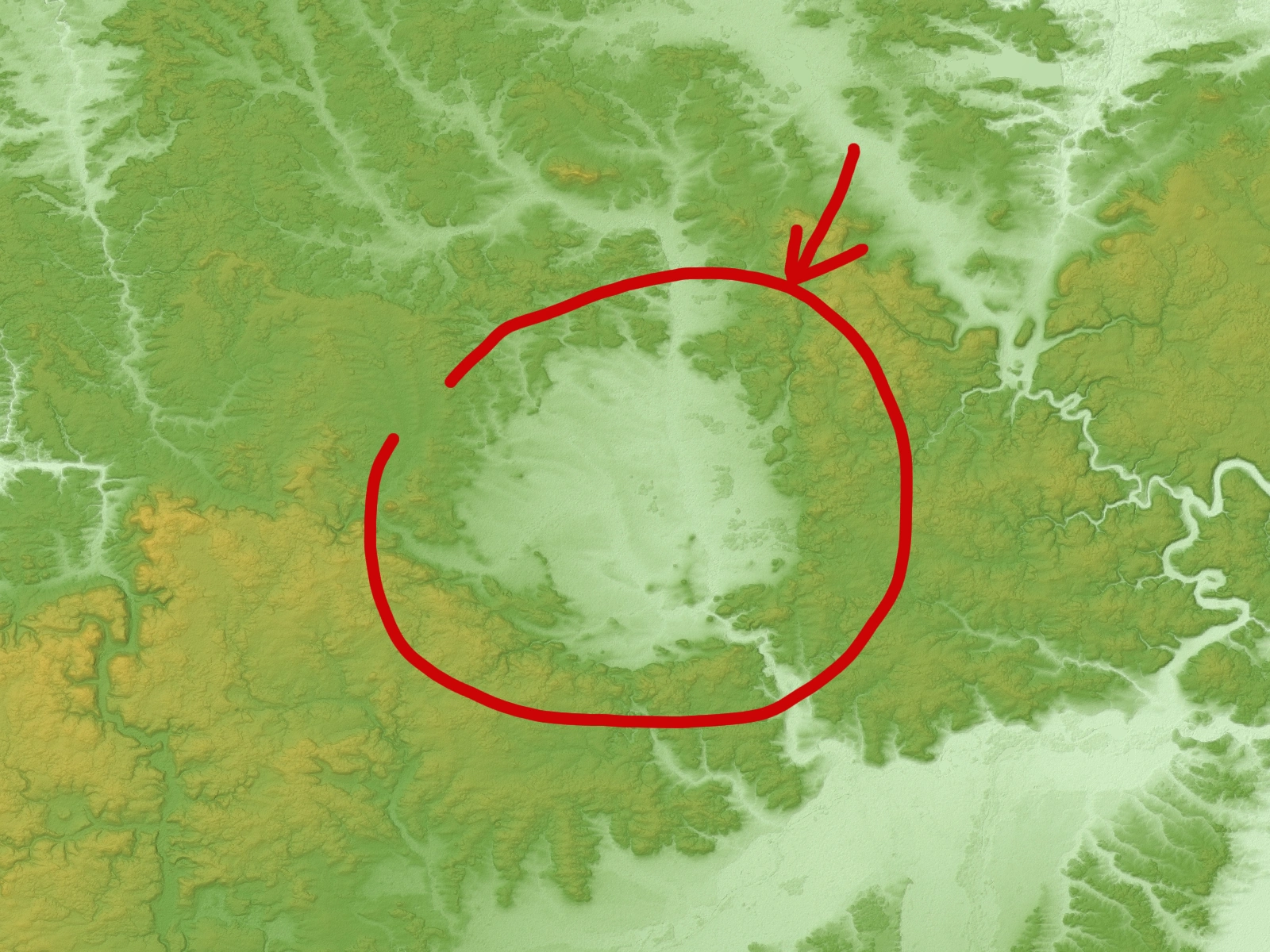
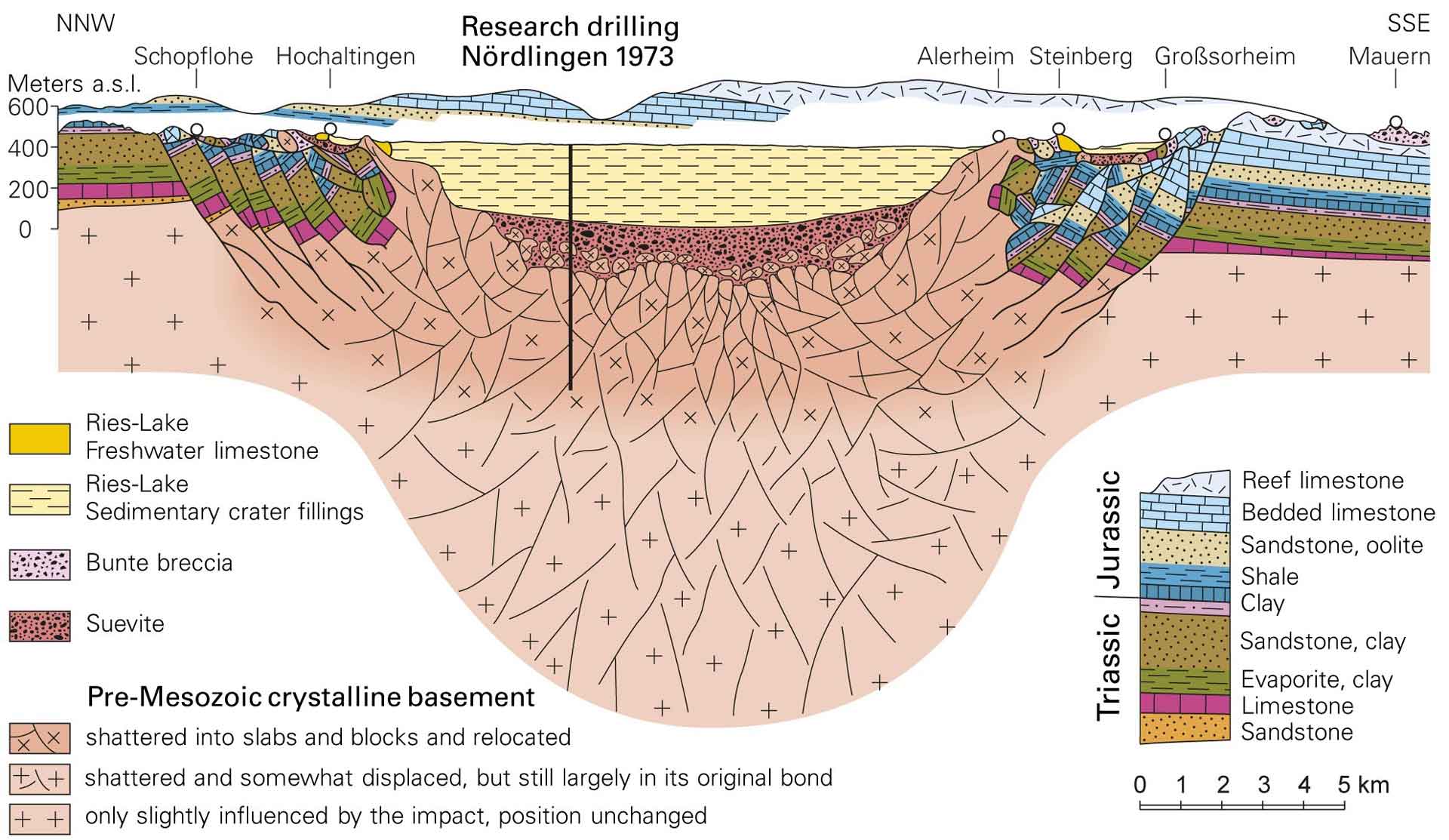
The explosion gouged a crater 24 kilometres across, known today as the Nördlinger Ries. The rocks at the impact point partly vaporised, partly melted, and the rest was flung outward as a vast blanket of debris. Ries is one of the best-preserved impact craters on Earth. Even after 15 million years it is visible in the landscape as a striking circular basin, roughly 150 metres deep — just look at a relief map.
The birth of moldavites hung by a thread. The green glass was fused only from a thin upper layer of Miocene sands that happened to lie on the surface at the time. Had the asteroid struck a little differently, or in a different geological era, no moldavites would exist today. It was a cosmic lottery — and southern Bohemia held the winning ticket.
A flight of hundreds of kilometres
The glowing melt was ejected from the crater with such force that it briefly left the atmosphere. It then rained down 200 to 450 kilometres east-north-east of the impact point, mainly across southern Bohemia. During the flight the melt cooled and solidified into discs, teardrops, and elongated droplets of natural glass. From Bavarian sand, above the heads of the animals of that era, something was born that we now wear as jewellery.
South Bohemia is the richest strewn field, but not the only one. Smaller strewn fields were later described by geologists in south-west Moravia, the Cheb region, Lusatia, and Lower Austria. All lie in a single fan pointing from the crater in exactly the direction the oblique impact directed the melt. Plot the localities on a map and you can read the ancient flight path at a glance.
What a moldavite actually is
A moldavite is natural glass, and chemically it is surprisingly simple: roughly 80 per cent silicon dioxide — the same substance as in quartz. Its hardness is 6.5 to 7, so it withstands everyday wear in jewellery. Under a loupe you can find many tiny bubbles and fine wisps of lechatelierite — pure silica glass that forms only at extreme temperatures. In nature it is created by a lightning strike in sand. Or by an asteroid impact.
And why green? It owes its colour to an unusually low iron content. All other tektites in the world contain more iron and are therefore brown to black; the moldavite alone transmits light in bottle-green tones. The characteristic wrinkled surface sculpture was etched by acidic groundwater over the millions of years the stone spent underground. No two pieces are alike — each bears the imprint of its own location.
Nördlingen — a town inside a crater
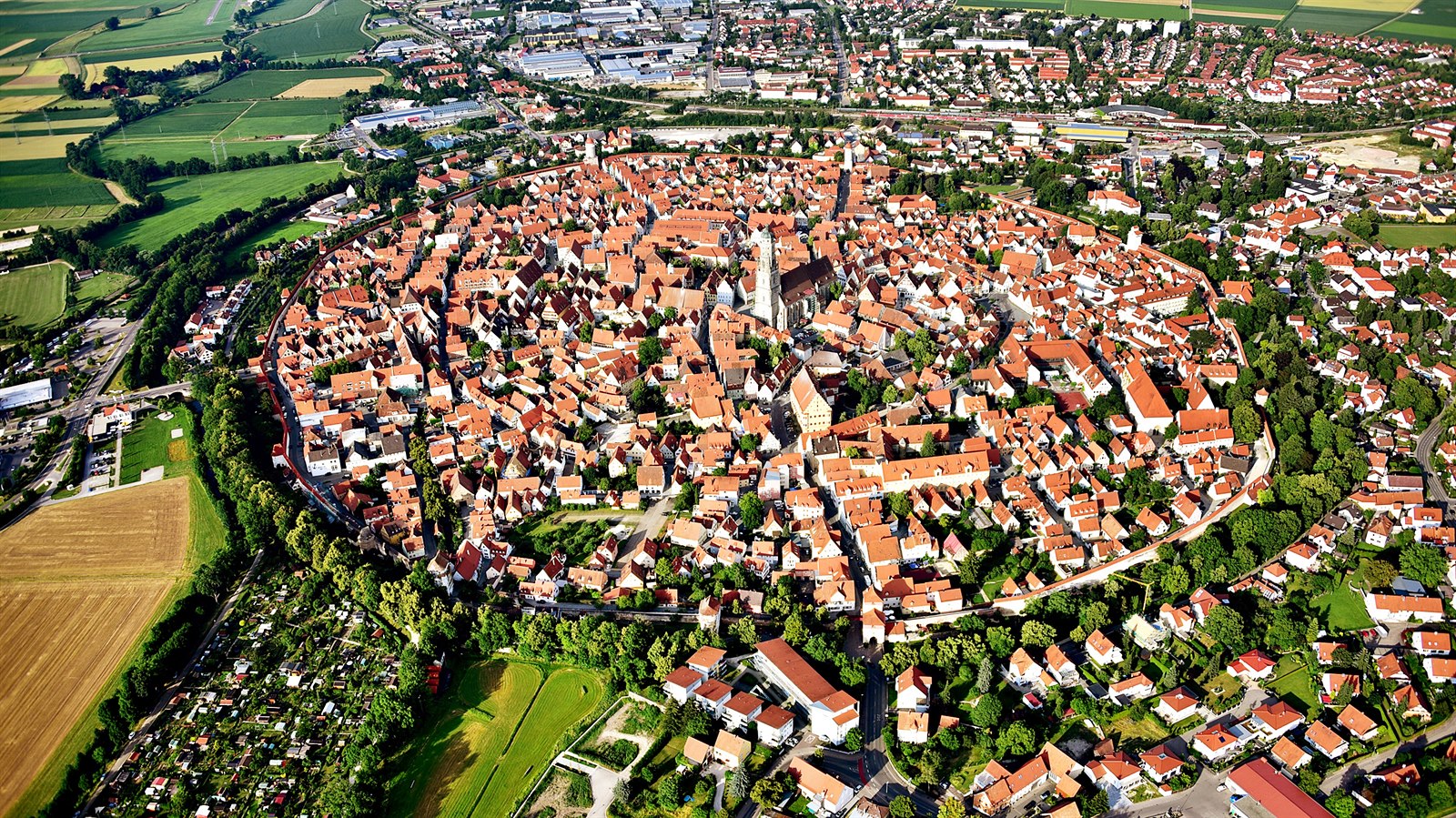
What remained at the impact site? In the middle of the crater lies the Bavarian town of Nördlingen, home to about 19,000 people. Medieval builders used the local stone to raise the town walls and the Church of St. George — unaware that they were building with suevite, rock created by the impact itself. The truth only emerged in the twentieth century when geologists recognised the typical impact breccia in the church walls. Until then the locals considered the crater an extinct volcano. From the church tower you can see the entire crater rim — a rounded ridge on the horizon.
Suevite hides a treasure: microscopic diamonds. The pressure of the impact converted graphite in the rocks into grains smaller than a third of a millimetre. More than 70,000 tonnes of them are locked in the crater rocks, and thousands of carats are estimated to sit in the church walls alone. You cannot get rich on them — they are too small and dispersed to mine. But few towns in the world can say they are literally built from diamonds.
First discoveries and record specimens
Moldavites were first described scientifically by Josef Mayer of Prague University. In 1786 he presented a report to the learned society about unusual green stones from near Týn nad Vltavou; he then considered them chrysolites. The name moldavite was given by F. X. M. Zippe in 1836, from the German name for the Vltava river — Moldau. The Czech word vltavín appeared in print for the first time in 1891, and since then we have had two names for this glass, both derived from the same river.
The record holder does not come from South Bohemia. The largest known moldavite was found near Slavice in Moravia and weighs around 260 grams — more than a quarter of a kilogram. In South Bohemia, even 100-gram pieces are rare; the largest there weigh 122 grams, with pieces up to 172 grams appearing only around Radomilice. The Moravian giant from Kožichovice (235 g) is on display at the National Museum in Prague. A typical find is tiny by comparison — a pebble that fits comfortably in the palm.
Rarer than gold and diamonds
30–60 t
all moldavites ever found
3,000+ t
gold mined every year
Some breathtaking arithmetic. All the moldavites that people have ever found over more than two centuries of collecting weigh an estimated 30 to 60 tonnes in total. Yet the world mines over 3,000 tonnes of gold a year — more in a single week than all the moldavites that have ever passed through human hands. And roughly 24 tonnes of diamonds are mined annually — about as much as the entire moldavite harvest since records began. All of this for a stone tied to a single place on the planet — no new occurrences will ever form.
The supply will never be replenished. Roughly 99 per cent of the glass created at impact has since been destroyed by erosion, and the remainder is scattered deep in sediments. The value of a particular stone is shaped by weight, integrity, and colour, but above all by location — Besednice pieces, for example, are prized among collectors for their exceptionally deep and sharp sculpture. The larger and more intact the piece, the greater the rarity.
Searching, digging, and the law
We will be frank, because the law is unequivocal. Gemstones are classified under § 3(1)(j) of Act No. 44/1988 Coll. (the Mining Act) as so-called reserved minerals and under § 5 form mineral wealth belonging to the state. A moldavite hidden underground therefore belongs to nobody who kicks it up — not even to the owner of the land on which it lies.
Moldavites may legally be mined only in two designated extraction areas, at Ločenice and Hrbov near Lhenice. Digging pits anywhere else is illegal: it violates the Mining Act, the rights of the landowner, and in forests also the Forestry Act. This is not a dead letter. The South Bohemia Police caught 45 diggers in just three and a half months of 2025; fines totalled 600,000 CZK, the highest being 91,000 CZK. Repeat offenders risk up to two years in prison.
What remains? Surface collecting — on your own land or on someone else's with the owner's permission, and always outside protected areas. After deep ploughing or heavy rain a field may still yield something today. It is the only form of searching that stays within the law. Everything else means gambling with a heavy fine, or something considerably worse.
Fakes and how to spot them
Counterfeits are nothing new. Bottle-glass imitations were sold as early as the start of the 20th century — and when gemologists examined five museum sets of moldavite jewellery from the 19th century, four of them turned out to be ordinary glass according to the GIA. Today's fakes come mainly from China. They are cast in moulds and their 'sculpture' is acid-etched, so they can fool even experienced buyers.
Fortunately, a real moldavite can be identified. Take a loupe and look for fine wisps of lechatelierite, abundant tiny bubbles, and schlieren — flow textures frozen in the glass. A plain UV lamp also helps: a genuine moldavite does not glow under ultraviolet light, whereas Chinese fakes fluoresce chalky white. These are the features forgers find hardest to replicate. For complete certainty, have the stone tested at a gemological laboratory.
And finally, common sense. A suspiciously large piece for a few hundred crowns? Real moldavites above 100 grams are museum rarities, not market stall merchandise. An overly perfect, repeating shape, a wet glassy sheen instead of a matt surface, and a price that looks too good to be true should all raise a red flag. When in doubt, have the stone assessed by an expert — or buy from a seller who guarantees its origin.